


Tech Tip: How to design the right flexible shaft for your application
When you need to transmit rotary power over, under, around or through obstacles, Elliott flexible shafts are the ideal solution.
Unlike rigid systems, our shafts simplify complex designs by overcoming challenges like non-linear routes, hazardous locations, limited access, misalignment and vibration to ensure safe, smooth and reliable performance.
To deliver the best possible solution, we need your input. By defining a few key parameters early in your design process, you’ll help our engineers create a flex shaft that meets your requirements.
Help our engineers design your flex shaft
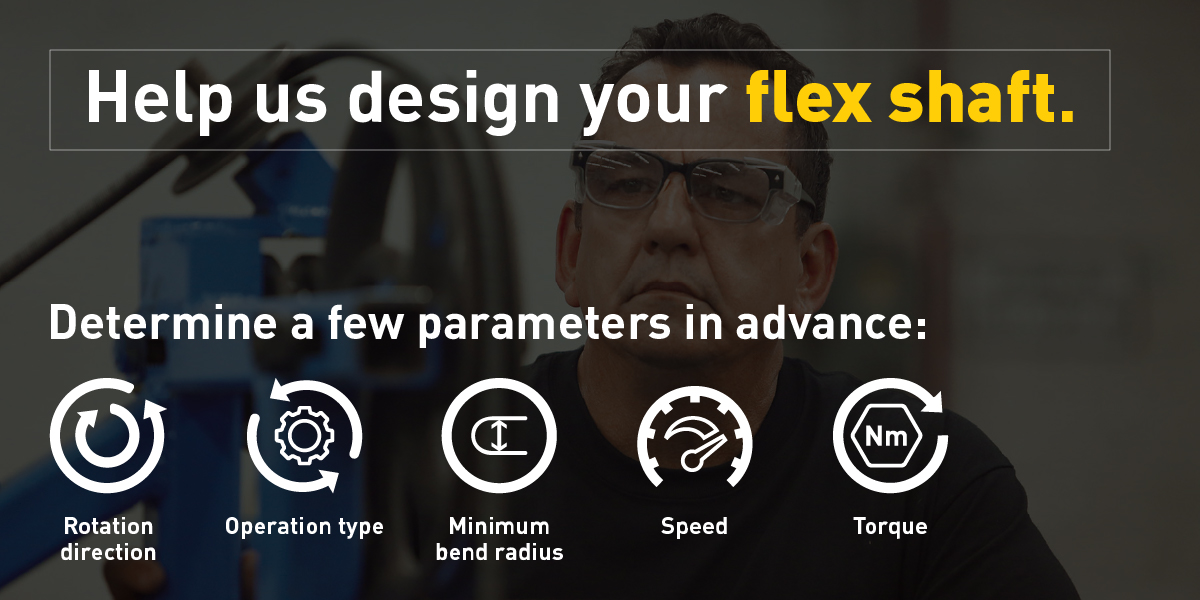
To ensure optimal performance, determine these key specifications in advance:
- Rotation direction: Confirm clockwise, counterclockwise or bidirectional. Operating in the opposite direction of the flex shaft’s design will decrease power transmission by as much as 30%, but flexible shafts can be designed to provide nearly equal performance in both directions.
- Operation type: Designate continuous or intermittent operation to ensure the flex shaft performs properly. For intermittent applications, note the duty cycle.
- Minimum bend radius: Use the actual bend radius as one of the factors to select the core size. Operating below a flexible shaft’s minimum bend radius causes the core to yield, fatigue and fail prematurely. Note that the minimum bend radius may be limited by the application’s required horsepower.
- Speed: Determine the continuous RPM, RPM vs. time profile or RPM vs. torque profile to appropriately match the flex shaft to the application. In general, transmitting horsepower at the highest possible RPM reduces the torque load on the flex shaft core.
- Torque: Determine start-up and running torque, torque vs. time profile or RPM vs. torque profile to appropriately match the flex shaft to the application.
- Horsepower: The motor used establishes the maximum HP, although transmittable HP may be limited by the application’s minimum bend radius.
- Path type: Understanding the path balances the need for flexibility, with stability, precision and power transmission capability.
- Length: Impacts torsional deflection, accuracy and control provided by the flex shaft.
- Approximate path and dimensions: Plays an important role in determining the operational load and speed the flex shaft will need to support.
Early design planning matters
Consider including flexible shafts early in your design process to save time, reduce complexity, enhance safety and help improve system reliability. Our team is here to help with additional questions about design, function, material or finish, as well as helping you determine if the torque, speed and environment of your application is appropriate for a flex shaft.
Ready to simplify your rotary power transmission?
No matter the industry, whatever the challenge, Elliott can deliver the power. We’ll help you turn the corner and make the connection. Visit our market pages to learn more about flex shaft applications.